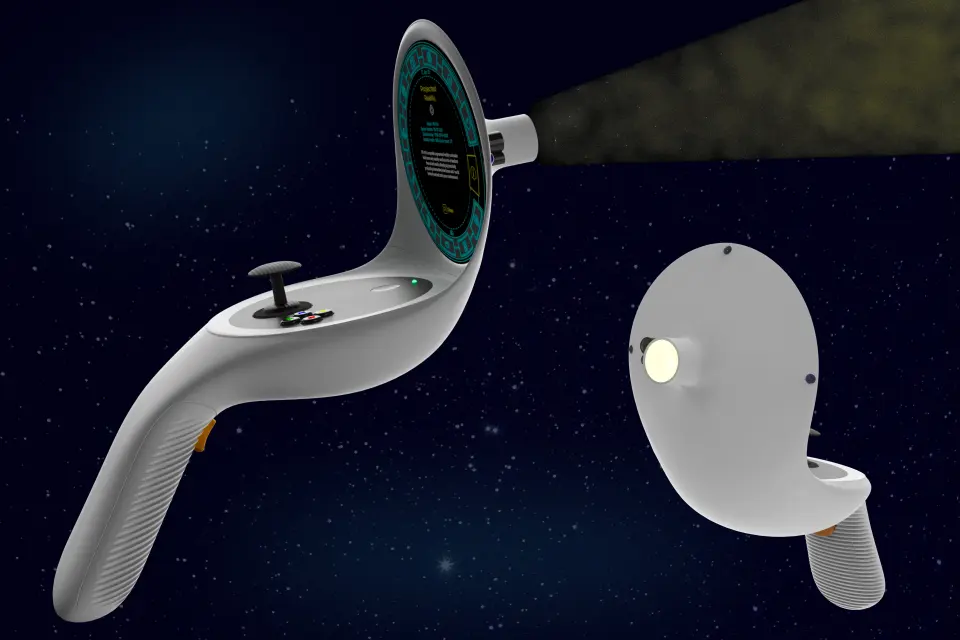
Spatial computing without the headset.
Master’s thesis, IIT Guwahati, 2025
Headsets isolate the people wearing them.
Headsets are heavy, run hot and cut you off from the room, and most users report headaches, nausea or dizziness.
Children love space but rarely see it.
From a planetarium in the hand to a new device.
The digital layer, moved from the eyes to the hand.
It turns the room into the interface.
Projected: the Adaptive OS hub in day mode, drawn after the board.
Onto any surface.
Choose a module and the interface inverts to true black: only the content is lit.
- 01EducationThe night sky for a classroom
- 02MedicalVeins on a hand
- 03IndustrySteps on a machine
- 04LogisticsStock in a warehouse
Form development was a dialogue between internal components and external ergonomics, solving for the heat of the projection unit.
One form, six finishes.
Colour, material and finish break the barrier between high tech and human comfort: an object that invites touch.
- Graphite
- Terrazzo and walnut
- Forged carbon
- Marble and oak
- Lilac clear
- Polar white
Two displays against visual fatigue.
Information is split between the far-field projection and a near-field instrument cluster, so the eye keeps shifting focal depth instead of holding one.
Tested in real-world light.
A working rig on a Raspberry Pi 4, an ESP32 and a 9-axis IMU, in a 3D-printed chassis.
Reality, made interactive.
| Role | UX and hardware designer |
|---|---|
| Electronics | Raspberry Pi 4, ESP32, 9-axis IMU, NIR camera |
| Tools | Raspberry PiArduinoKStars3D printingCAD |
| Thesis | Master’s thesis, IIT Guwahati, supervised by Dr. Pankaj Upadhyay |
| Year | 2025 |
| Method | Design Thinking
|